Learn how CPA networks help game publishers drive player acquisition, reduce UA waste, and deliver measurable ROAS for F2P PC games.
We always call ourselves the #1 CPA performance marketing network in video games. We say it a lot — on our website, our LinkedIn, in meetings, probably in our sleep too.
But here's the thing: if "CPA network" doesn't click with you right away, none of that matters, right?
So we wrote the guide we wish existed when we started — what a CPA performance network actually is, how it works, why game publishers use them, and what separates a great one from a mediocre one. (Spoiler alert: we're the great one. 😉)
No jargon dumps. No fluff. Let's get into it.
What Does CPA Mean in Performance Marketing?
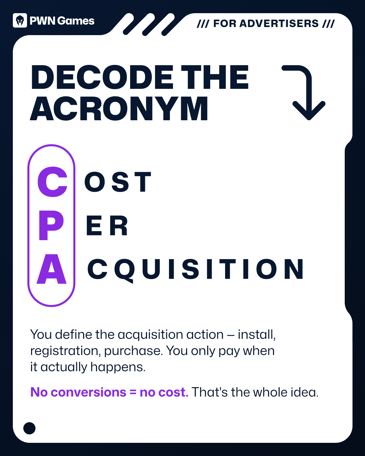
CPA stands for Cost Per Acquisition (sometimes also called Cost Per Action). It's a paid advertising model where you define a specific acquisition action — a game install, a player registration, a first purchase, a tutorial completion — and you only pay when that action actually happens.
Not when someone sees your ad. Not when someone clicks on it. Only when a real person does the specific thing you agreed counts as a conversion. No action, no cost.
To put that in context, here's how CPA compares to the other common pricing models in digital advertising:
| Model | What You Pay For | The Reality |
|---|---|---|
| CPM (Cost Per Mille) | 1,000 ad impressions | Someone sees your ad — you pay. Whether they click, install, or scroll right past it. |
| CPC (Cost Per Click) | Each click on your ad | Better than impressions, but a click doesn't mean a player. You're still hoping the click converts. |
| CPA (Cost Per Action) | A completed action you defined | Install, registration, purchase — you pay only when someone does the thing that actually matters to your game. |
The bottom line: with CPM and CPC, you're paying for exposure and hoping it turns into players. With CPA, you're paying for the players themselves.
So What Is a CPA Network, Exactly?
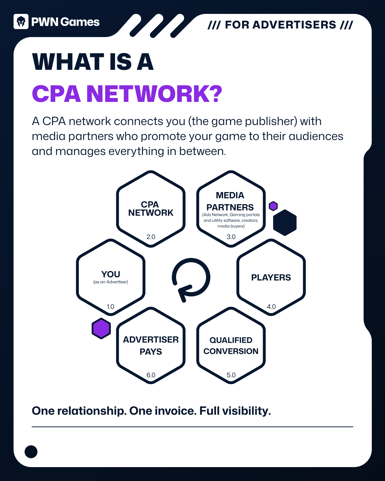
A CPA performance marketing network is the company that connects advertisers — game publishers like you — with media partners who promote your game to their audiences.
At PWN Games, that means a curated ecosystem of 1,500+ vetted traffic sources specialized in PC gaming. This includes not only major ad networks like Meta, Google, and Taboola, but also exclusive traffic sources you won’t find through standard channels—gaming portals and utility software (like Opera GX), content creators, independent media buyers, niche affiliate marketers in the video game vertical, and more.
The network manages the entire ecosystem: partner recruitment, conversion tracking, fraud prevention, campaign optimization, and payments. You get one relationship, one invoice, and full visibility into what's working.
How a CPA Campaign Works, Step by Step
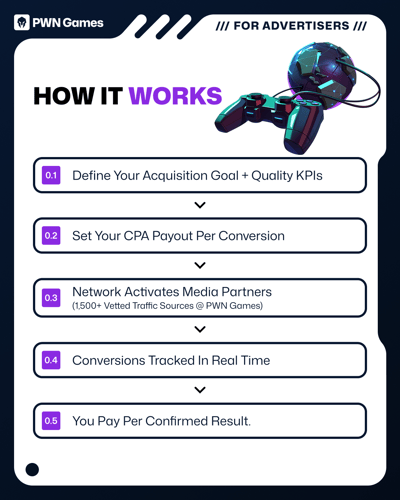
1. You, the advertiser, define acquisition goal and requirements
What counts as a qualified acquisition? Are there specific traffic sources or methods you want to allow — or restrict for brand safety? This is where you set the rules.
For most F2P PC games, an acquisition is typically defined as a registration or a client install. However, some publishers go a step further — adding retention thresholds (such as D1 or D7 retention) or even first purchase events.
At PWN Games, this is something we strongly recommend. Our goal isn’t just to drive high install volume — it’s to help you acquire sustainable, high-value players.
2. You, the advertiser, set your CPA payout. This is how much you’re willing to pay for that specific Acquisition/action.
If you set a $10 CPA for a registration, every new player who registers through the network costs you exactly $10. That's your cost of acquisition, locked in.
3. The network activates its media partners. A strong CPA network (like PWN Games) has hundreds of vetted traffic sources — ads network, gaming portals, content creators, media buyers, gaming communities — who start driving players to your game.
4. Everything gets tracked in real time. Through server-to-server postback tracking, conversion pixels, or SDK integrations, every click, every install, and every traffic source is measured. You see which partners deliver and which don't.
5. You pay for confirmed conversions. The network pays the partners. The network handles all downstream media partner payouts. You get consolidated billing, transparent reporting, and zero hassle managing dozens of individual partnerships.
Why Do F2P Game Publishers Use CPA Networks for Player Acquisition?
Free-to-play games have a unique challenge: you need to acquire players at scale, but only a fraction of those players will ever spend money. That means every dollar of your user acquisition budget has to work harder.
Here's why the CPA model is built for this:
Predictable player acquisition costs
When your CPA is $15 per registration, the math is simple. 1,000 players = $15,000. No surprise invoices, no budget overruns from impression-heavy campaigns that didn't convert. Your finance team can plan around real numbers.
Zero spend on traffic that doesn't convert
With impression or click-based campaigns, you can rack up 50,000 clicks and end up with 200 actual players. With CPA, you only pay when someone shows up. The gap between "ad spend" and "players acquired" disappears.
Incentive alignment between you and your traffic sources
This is the part that really matters. In a CPA model, media partners only earn when players convert. That means they're naturally motivated to send quality traffic — real people who are actually interested in your game. Bad traffic earns them nothing. The incentive structure does the quality filtering for you.
Scalable without changing the economics
Found a traffic source delivering players with strong retention at your target CPA? Scale it up. The unit economics stay the same. You're not bidding into rising CPMs or watching your cost-per-click spike as you increase budget.
💡 A note on "Cost" vs. "Quality": CPA isn't about getting the lowest possible cost per install. A $15 CPA for a player who sticks around for 30 days and spends money is worth far more than a $0.50 install from someone who opens your game once and never returns. Smart CPA campaigns optimize for player quality and lifetime value, not just volume.
How to Evaluate a CPA Network for Gaming
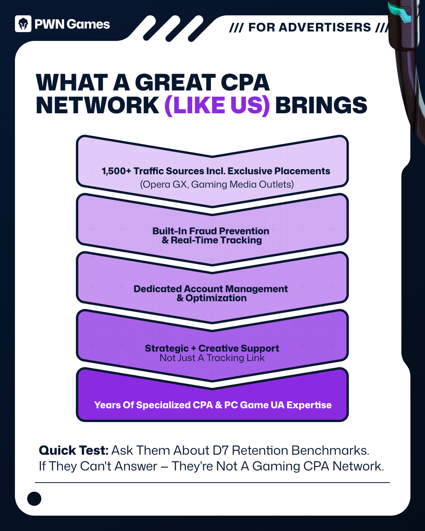
Not all CPA networks are built the same. A network that runs gaming offers alongside weight loss supplements and crypto isn't going to understand your player acquisition goals. Here's what to look for:
| What to Evaluate | Why It Matters for Game Publishers |
|---|---|
| PC Gaming specialization | A network that understands the gaming industry, the PC F2P model, and retention benchmarks will optimize very differently from a generalist. |
| Size and quality of media partner base | How many partners? How are they vetted? Do they include gaming-specific traffic sources like gaming portals, Discord communities, and content creators? |
| Fraud prevention capabilities | What detection systems are in place? Bot filtering, click fraud analysis, conversion validation — this is non-negotiable |
| Tracking and reporting platform | Real-time dashboards, granular source-level data, API access. You need full visibility into campaign performance |
| Account management quality | Do you get a dedicated manager? How proactive are they with optimization? Weekly reviews or quarterly check-ins? |
| Pricing model flexibility | Can you run CPA, CPI, revenue share, or hybrid models depending on your goals? |
| Creative and strategic support | Can they produce ad creatives, landing pages, and media plans — or do you supply everything? |
| Proven results in your genre | Ask for case studies, client references, and specific performance benchmarks for games like yours |
Here's a quick litmus test: ask the network what D7 player retention looks like across their best traffic sources. If they can't answer that question — or don't understand why it matters — they're not a gaming performance network. They're a generalist running gaming offers on the side.
If you're curious how PWN Games stacks up against that checklist — we're happy to walk you through it. No pitch deck, just a straight conversation about what we can (and can't) do for your game. Book a strategy call →
Common Questions About CPA Networks (Answered)
"Is CPA advertising only for games with big marketing budgets?"
No. CPA campaigns can start with test budgets of $5,000–$10,000 per month. You won't hit massive scale at that level, but you'll generate enough conversion data to evaluate whether the model works for your game. Most publishers scale to $30,000+ monthly once they've validated performance.
"If I'm paying per action, won't the traffic quality be low?"
The opposite, actually. Because affiliates only earn when real players convert, they're incentivized to send engaged users — not junk traffic. Layer in the network's fraud prevention, and traffic quality typically goes up compared to running broad impression-based campaigns yourself.
"Can't I just run paid ads on Meta and Google instead?"
You can and probably should — as part of your overall UA mix. But a CPA network gives you access to hundreds of additional traffic sources beyond the major ad platforms: gaming communities, niche websites, affiliate marketers, content creators, display networks. It's channel diversification. And for user acquisition at scale, diversification is how you find volume without hitting a ceiling on a single platform.
"Aren't all CPA networks basically the same?"
Not even close. A gaming-specialized CPA network understands the difference between a high-LTV whale and a one-session bounce. They know which traffic sources deliver players who retain at D7 and which ones produce install-and-quit users. That specialization changes how every campaign gets built, optimized, and scaled.
"How long does it take to see results from a CPA campaign?"
Most campaigns launch within 1–2 weeks of setup. You'll see initial conversion data immediately, but meaningful optimization takes 30–90 days. That's the window where your network learns which traffic sources, creatives, and geos perform best for your specific game. Patience during this testing phase pays off in long-term performance.
Is a CPA Performance Network the Right Fit for Your Game?
A CPA network is likely a strong fit if:
- You're publishing a free-to-play PC game and need to acquire players at a predictable, performance-based cost
- You want to scale user acquisition beyond Meta, Google, and your existing paid channels
- You care about player quality and retention metrics, not just raw install volume
- You want advertising spend tied directly to measurable results
It may not be the right fit if you're focused purely on brand awareness (that requires a different strategy) or if your game doesn't have conversion tracking set up yet (however we at PWN Games can help you out sorted out).
Key Takeaways
- CPA means you only pay when a player takes a defined acquisition action — install, register, purchase. No conversions, no cost to you.
- A CPA network manages the full media partner ecosystem — including partner recruitment, real-time tracking, fraud prevention, optimization, and consolidated payments.
- For F2P PC games, cost-per-action advertising aligns incentives perfectly. Media partners earn by delivering players who actually convert, not just impressions or clicks.
- Gaming specialization matters. A network that understands player lifetime value, retention benchmarks, and F2P monetization will outperform a generalist every time.
- CPA isn't about the cheapest installs — it's about accountable, performance-based spending that ties your ad budget directly to player acquisition results.