A grounded breakdown of the top attribution solutions for PC game publishers — based on a decade of hands-on PC game growth work.
Over the past decade, we've run tens of thousands of performance marketing campaigns for PC game publishers of all kinds — from mobile-first teams launching PC ports to established PC and console publishers shipping AAA F2P titles.
We operate everything on a CPA model, where advertisers only pay for verified, valuable acquisitions. In this setup, attribution isn’t a “nice-to-have” — it’s the backbone of the entire system.
After working across nearly every major attribution solution and a wide range of publisher setups, one thing is clear: there’s no universal “best” tool. The right choice depends on your game, your tech stack, and your growth model.
What follows is a grounded breakdown of how to choose the right attribution setup, based on years of hands-on experience across hundreds of PC game projects.
The State of PC Game Attribution in 2026
PC attribution sits in a fundamentally different place than mobile.
On mobile, the infrastructure is mature — SDKs, MMPs, IDFA (now heavily constrained by Apple's ATT framework), SKAdNetwork, and Google's GAID combine to give most teams a reasonably consistent measurement layer within a well-defined ecosystem. Privacy changes have eroded the edges, but the core still works.
PC has no equivalent. There's no universal device ID. Steam, which controls roughly 75% of PC digital distribution, doesn't expose user-level data to marketers the way the App Store and Google Play do. Epic, GOG, Microsoft Store, and proprietary launchers all play by different rules. And players bounce across devices — seeing an ad on their phone, checking a review on their laptop, then installing on their desktop gaming PC three days later — with no shared identifier holding the journey together.
Read more on why PC game user acquisition shouldn't be done like mobile and what you should do for your PC Game UA
The practical consequence is that probabilistic attribution (fingerprinting, identity graphs, modeled conversions) takes a significant portion of cross-ecosystem PC attribution. Anyone selling you 100% deterministic PC attribution in 2026 is selling you something that doesn't exist. So, the right question isn't "how do I get perfect attribution for my PC game?" — it's "which solution gets me close enough, in the channels that actually matter for my game?"
That's the lens we'll use to break down the options.
Marketing Attribution Fundamentals: What's Actually Happening Under the Hood
Before we compare tools, it’s important to understand how attribution actually works at a fundamental level. Once you know what’s happening under the hood, choosing the right setup becomes significantly clearer and more straightforward.
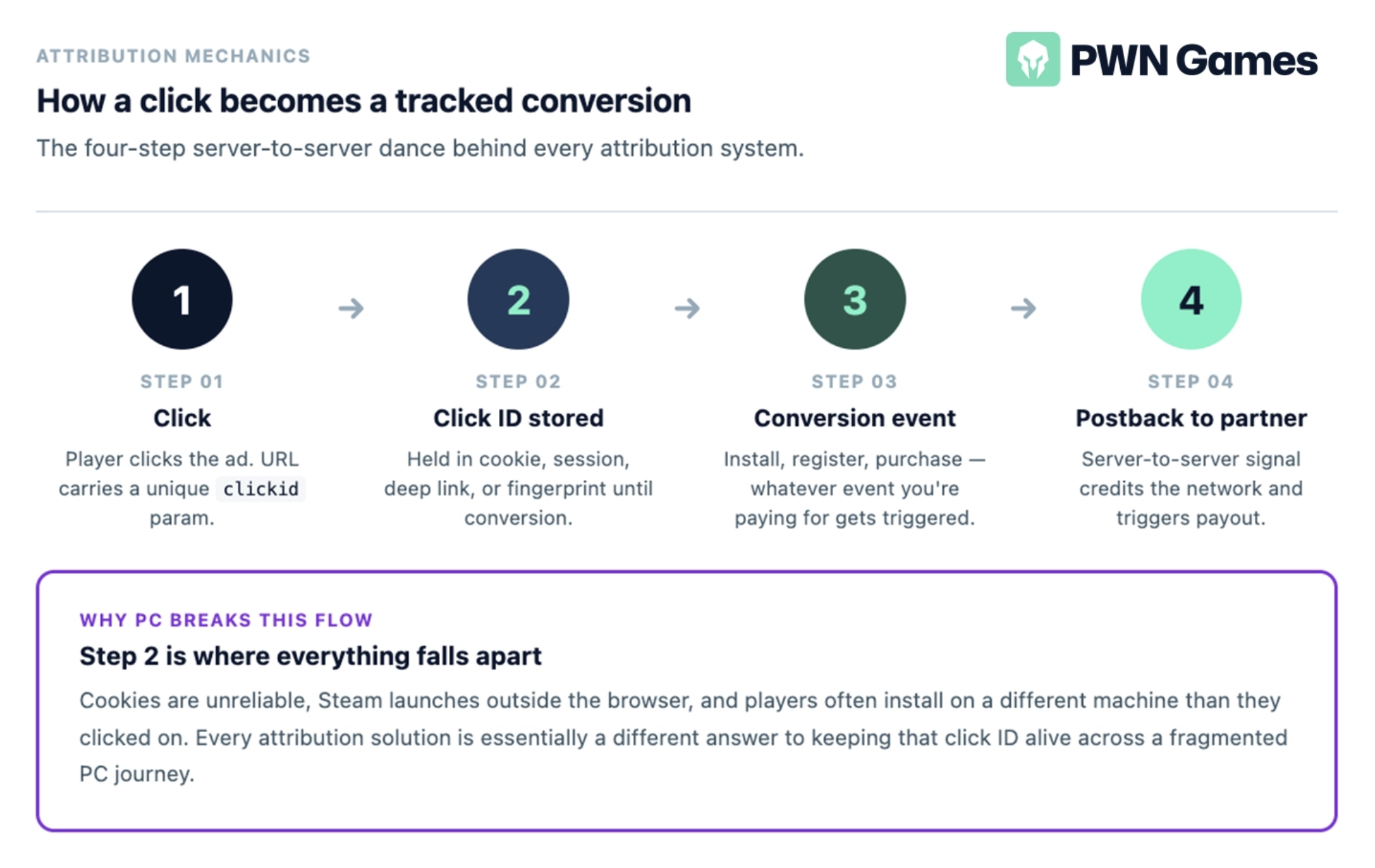
A click ID is generated when a player clicks an ad. It's a unique string that gets passed in the URL (?clickid=abc123).
That click ID gets stored somewhere — a cookie, a server-side session, a deep link parameter, a fingerprint — until the player converts.
A conversion fires when the player does the thing you're paying for: installs the game, registers, hits Steam, makes a first purchase, reaches a level, whatever you've defined.
The attribution layer matches the conversion back to the click ID, then fires a postback — a server-to-server signal — to whichever ad network or media partner gets credit. That postback is what tells the media partners that "you earned this conversion, here's the payout, optimize for more of these."
Everything else — dashboards, MMPs, in-house BI, multi-touch attribution models — is just different ways of doing this same dance with different trade-offs around accuracy, cost, and complexity.
The reason PC is hard: that "click ID stored somewhere" step is messy. Cookies are unreliable. Steam launches outside the browser. Players install on a different machine than they clicked on. Every attribution solution we're about to discuss is essentially a different answer to how do we keep that click ID alive across a fragmented PC journey? And the honest answer is: nobody does it perfectly. The best you can do is pick the trade-off that fits your game.
Choosing the right PC game attribution platform in 2026
Important Note: What follows are subjective perspectives based on our experience working with a wide range of game studios. We strongly recommend doing your own research and reaching out directly to the platforms you're considering. Every situation is different, and each platform is constantly updating its services—so treat this as a starting point, not the final word.
In practice, PC game attribution is rarely fully in-house. Even the largest publishers invest heavily in internal data and BI infrastructure, yet still rely on third-party tools for cross-platform measurement, network integrations, and specialized channel tracking (e.g., creators, CTV). The real question for most teams isn’t “build or buy?”—it’s “which third-party solution fits our setup, and how does it complement what we already have?”
Based on our experience working with various game publisher clients, we’ve grouped PC game attribution solutions into three broad types—each built around different priorities.
The tools highlighted below (AppsFlyer, Adjust, Gamesight) are among the most prominent in each category—not the only options, but representative ones. The goal is to help you identify which approach fits your setup, then explore the vendors within that category.
Let's break them down.
Type A: Mobile-First MMP with PC Coverage (e.g., AppsFlyer)

Overview:
Built primarily for mobile attribution at scale and recognized as the #1 MMP (mobile measurement partner) as of 2026, AppsFlyer has also notably expanded its attribution support into PC & console games in recent years, with coverage across major digital storefronts including Steam, the Epic Games Store, the Microsoft Store, PlayStation, Xbox, and Nintendo Switch.
Strengths:
- Leading mobile attribution capabilities, including mature fraud detection, deep linking, and audience features
- Strongest mobile ad network integrations and partner ecosystem in the category
- Familiar workflow for teams already operating mobile UA stacks
- Support cross-platform reporting that unifies mobile, PC, console, web, and CTV at a consolidated dashboard level
- Transparent pricing with multiple clearly defined tiers based on company needs and usage.
Considerations:
- PC/console is not the center of gravity. AppsFlyer has the largest mobile customer base to keep happy, so PC/console features compete with mobile priorities for roadmap attention
- PC/console attribution is solid but still an extension of a mobile-DNA platform — game-activation logic, storefront UTM nuances, and influencer-heavy funnels aren't its native habitat
- Pricing is built around a mobile-first feature set—so for PC-focused titles, you may be paying for capabilities that aren’t fully utilized.
Best Suited for:
Mobile-first publishers porting mobile games to PC, where PC is a secondary platform and consistency with an existing mobile stack is the priority.
Type B: Mobile-Born MMP with Strong PC Investment (e.g., Adjust)

Overview:
Originally built for mobile attribution, Adjust has evolved into a robust cross-platform measurement solution supporting mobile, PC, and console multi-platform games. It provides dedicated capabilities for PC and console, with coverage across major platforms including Steam, the Epic Games Store, PlayStation, Xbox, and Nintendo. It was also the launch partner for Google’s Play Install Referrer API for Google Play Games on PC, reinforcing its position as an pioneer in PC–mobile cross-platform attribution.
Strengths:
- Comprehensive cross-platform coverage (mobile, PC, console, web, CTV) with multi-platform measurement built as a core capability rather than a side feature.
- Google's launch partner for the Play Install Referrer API expansion to Google Play Games on PC (though competing MMPs now offer similar integrations.)
- Mature fraud prevention capabilities developed in high-volume mobile advertising environments
- Flexible, tiered pricing based on company needs, generally seen as competitive in cross-platform deals based on multiple client feedback.
Considerations:
- Product and UX still reflect mobile-first design assumptions (key channels, terminology, dashboards, and event models built around app installs)
- Still less mature ecosystem for PC-native channels such as influencers, Discord, and gaming performance networks like PWN Games, compared to PC-specialist platforms (Type C)
Best Suited for:
Cross-platform studios operating mobile + PC + console together, especially those prioritizing fraud prevention, scalability, and centralized attribution.
Type C: PC and Console-Native Specialist (e.g., Gamesight)

Overview:
Built specifically for PC and console ecosystems, with deep integration into platforms like Steam, Epic Games Store, Xbox, PlayStation, and Nintendo Switch. Focused heavily on PC-native acquisition channels such as creators, community-driven traffic, and CTV.
Strengths:
- Purpose-built for PC and console games — not a mobile MMP retrofitted for PC gaming
- Comprehensive PC-native channel measurement across Twitch, YouTube creators, Discord, and PC gaming performance networks like PWN Games
- High Accuracy even with probalistics data: Vendor-reported ~90% fingerprint accuracy on PC, ~83% on console
- Enterprise-friendly: data warehouse postbacks, self-hosted/hybrid SaaS, SAML, and 80+ ad network integrations, including PC gaming–focused networks.
- Designed around PC marketing workflows (key channels, terminology, aquisition funnel)
- Multi-touch attribution and full-funnel coverage including in-game purchase, retention, and DLC measurement.
Considerations:
- Less transparent pricing without published tiers, and is frequently cited as being on the pricier side, likely due to its unique PC specialization and feature depth.
- No native mobile attribution — cross-platform titles still need an MMP alongside it (an official Adjust ↔ Gamesight integration exists, but requires shared account identity between mobile and PC/console editions and adds the cost of running two tools)
Best Suited for:
PC-first or PC-and-console publishers running heavy investment in creators, community-driven acquisition, and CTV-based campaigns.
A Note on PWN Games
PWN Games isn't a game attribution platform itself. But because we run your PC game user acquisition on a CPA model, accurate attribution is critical to how we operate — which is why PWN Games includes a built-in attribution layer: a server-to-server (S2S) postback solution that handles all traffic flowing through our network out of the box. No extra cost, fraud prevention built-in, ready on day one.
For publishers running their own game launcher, our built-in S2S postback setup is often all you need on the PWN Games side. Your conversion data flows directly from our tracking layer to your systems via server-to-server postbacks — no redirects, no cookies, no estimation.
If you need to go beyond that — into full user lifecycle cross-channels measurement — that's usually where probabilistic attribution comes in. PWN Games supports integration with all major third-party attribution platforms. Whether it's AppsFlyer, Adjust, Gamesight, or any other third-party or in-house platform, we integrate cleanly with each of them on our side, and our experience working across these setups is part of what we bring to the table. The attribution piece works no matter what solution you're using.
Getting attribution right is one thing. Getting players at a price that works is another. Book a call with PWN Games — we'll talk through both and where your game fits in.
How to Pick the Right Game Attribution Platform: Questions to Ask Yourself
A quick reminder: what follows are subjective perspectives based on our experience working with a wide range of game studios. We strongly recommend doing your own research and reaching out directly to the platforms you're considering. Every situation is different, and each platform is constantly updating its services—so treat this as a starting point, not the final word.
We work with studios across the full spectrum, and the picking process generally collapses to a few real questions.
1. What platforms does your game live on?
- Mobile-primary, with a PC port → Type A (e.g., AppsFlyer) is the natural extension
- True cross-platform (mobile + PC + console as first-class) → Type B (e.g., Adjust) is the strongest 2026 bet
- PC-first or PC + console as the primary platform → Type C (e.g., Gamesight) is purpose-built for PC and console game
- Smaller studio, just starting out → start with whatever your performance marketing network provides natively, then layer in a third-party platform as you scale
2. How much does fraud cost you? At sub-$50K/month spend, fraud is annoying. At $500K+/month, fraud is a P&L line item. The mobile-born MMPs (Type B) have spent years hardening their fraud prevention against mobile's nastier abuse patterns, and that maturity carries over. In our experience, Type B has slightly more mature fraud tooling than the PC-native specialists in 2026— though every platform has its own approach and Gamesight's own fraud suite is genuinely capable. If you're scaling programmatic, mobile UA, or affiliate traffic at volume, this is a category worth pressure-testing in vendor conversations.
3. How much do you need PC-native channel depth? If creators, Twitch, CTV, and Steam wishlist campaigns are your primary spend, Gamesight's specialization is worth the premium. Their Steam integration, wishlist tracking, and creator attribution aren’t features you can replicate by simply configuring a traditional MMP.
4. Do you have your own game launcher, and is that where most of your installs land?
If yes, a server-to-server (S2S) postback setup with deterministic attribution may be all you need — that's exactly what PWN Games' built-in S2S postback layer provides out of the box. If your game is primarily distributed through third-party stores like Steam or the Epic Games Store, you'll likely need a more advanced solution that combines deterministic attribution with mature probabilistic fallback — typically through a third-party platform like Gamesight.
5. What level of measurement and attribution do you actually need?
For a single acquisition campaign on its own — say, a PWN Games campaign — our own measurement layer may be all you need, especially if you run your own game launcher. PWN Games' built-in S2S postback setup feeds directly into your internal BI layer with deterministic attribution data, which is more accurate than probabilistic matching and clean enough to cover that campaign end to end, with no extra platform required on your side.
Where a third-party attribution platform earns its keep is full cross-channel user lifecycle measurement. If that's what you need, PWN Games integrates cleanly with all the major options such as AppsFlyer, Adjust, Gamesight, and any other third-party or your in-house platform. The attribution piece works no matter what solution you're using.
What This Means For You
If you're a UA manager at a game publisher: Audit your current attribution setup this quarter. Export 90 days of conversion data and trace it back — can you actually tell which dollar of spend produced which paying player? If not, that's your priority.
If you're at a smaller studio scaling UA for the first time: Don't overbuild. Lean on what your performance marketing network provides natively for your CPA and affiliate traffic. Layer in a third-party platform — Type B if cross-platform is in your near future, Type C if you're going PC-and-console deep — when your monthly UA budget crosses the point where 2–3% of it would pay for the tool.
If you're running cross-platform: Pick your unifier carefully. The cost of switching attribution platforms after 18 months of historical data is brutal. Type B (e.g., Adjust) is the safer cross-platform bet today; Type C (e.g., Gamesight) is the better PC-native bet; Type A (e.g., AppsFlyer) is the right answer if mobile is your primary. There's no third option that wins all three.
If you're porting from mobile to PC: Type A is the lowest-friction path if you're already on it. But evaluate Type B seriously — for a game where PC will become a meaningful share of revenue, Type B's PC-side investment is currently more aggressive
Want to talk through your PC game growth? Attribution is foundational, but it’s just one piece of the broader PC game UA picture. Book a call with PWN Games— we’ll cover everything you need to scale your PC game.
Want more like this in your inbox? Subscribe to the PWN Games newsletter for monthly tactical breakdowns on PC game user acquisition, performance marketing, and the stuff most agencies won't tell you.
PWN Games is a CPA performance marketing network specializing in PC gaming. We work with leading PC F2P publishers — including Tencent Games, NetEase Games, and Wargaming — connecting them with our 1500+ vetted traffic sources to deliver high-quality player acquisition at predictable costs.